
Important
- Midterm Format – The upcoming midterm consists of 60 multiple-choice questions and three short-answer questions covering the first five topics/chapters, and no cheat sheets are permitted.
- Textbook Material – Students are expected to read the textbook to supplement class material; test questions drawn from the textbook will expand upon the core content already covered in lectures.
- Case Studies – It is important to know the details and outcomes of highlighted case studies, such as the R. v. Oickle case.
- Historical Figures – Students must understand the key contributions of important names in the field, such as Hugo Munsterberg and his work demonstrating the importance of eyewitness testimony.
Core Concepts
- Jury Functions: The two primary legal functions of a jury in criminal cases are to decide the facts based on trial evidence and to render a verdict (which must be unanimous), using the standard of “beyond a reasonable doubt.”
- Jury Selection: The process involves summoning a pool of potential jurors (the venire) and selecting the final panel (voir dire) while ensuring they represent the community and are unbiased.
- Representativeness: A fundamental characteristic requiring that a jury composition accurately reflects the community where the crime occurred, which is achieved through randomized selection from community lists.
- Impartiality: A fundamental characteristic requiring that jurors set aside any pre-existing biases, prejudices, or attitudes, and judge the case solely based on admissible evidence, ignoring external factors like media.
- Challenge for Cause: A legal mechanism used during jury selection to dismiss a potential juror based on a specific and forceful reason to believe the person cannot be fair or unbiased.
- Jury Nullification: A phenomenon that occurs when a jury chooses to ignore the law and the evidence, rendering a verdict based on other criteria, such as a belief that the law itself is unjust or the punishment is too harsh.
- Pretrial Publicity: Negative media attention regarding a case prior to the trial, which can bias potential jurors and increase the likelihood of a guilty verdict, sometimes requiring a change of venue or adjournment.
- The “CSI Effect”: A modern trend where viewing forensic-based crime television shows artificially increases the expectations of jurors concerning the presence and quality of forensic science evidence (e.g., DNA, fingerprints) in real criminal trials.
- Backfire Effect: A psychological phenomenon where a judge’s instruction to jurors to disregard inadmissible evidence actually causes the jurors to pay more attention to it and incorporate it into their beliefs.
- Defendant and Victim Characteristics: Extralegal factors—such as physical attractiveness, race, or gender—that can inappropriately influence a jury’s verdict or sentencing recommendations.
Theories and Frameworks
- Mathematical Models: A theoretical approach suggesting that jurors make decisions by conducting a set of mental calculations, weighing the strength and importance of various pieces of evidence to calculate a final verdict.
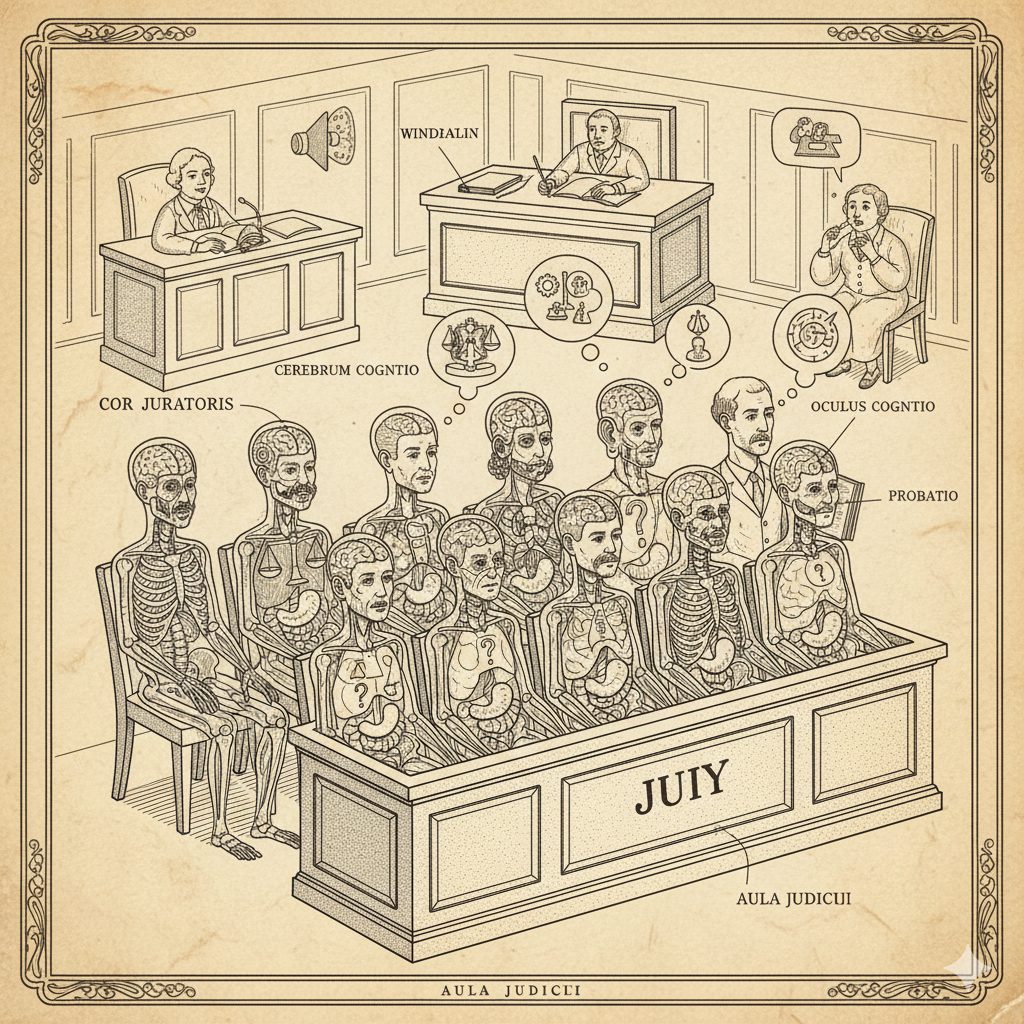
- Story Model: An explanation-based framework proposing that jurors actively organize and interpret trial evidence into a coherent narrative or “story,” which they then match to the most appropriate verdict category.
- Chaos Theory: The theory predicting that when jurors are guided by their emotions and personal biases rather than strictly by the law (such as during jury nullification), chaos and inconsistency in legal judgments result.
- Polarization: A group dynamic during jury deliberations where an individual’s initial leaning (e.g., toward guilt) becomes more extreme after discussing the evidence with like-minded group members.
- Leniency Bias: A phenomenon during jury deliberations where a jury that is initially evenly split (e.g., 50/50) tends to gravitate toward greater leniency and ultimately reach a not-guilty verdict.
- Director’s Cut Model: An individual-level decision-making model proposing that jurors use evidence to form a narrative, placing them into cognitive states such as a believer, doubter, muller, or puzzler.
- Story Sampling Model: A jury-level deliberation model proposing that final decisions arise from the sharing of individual stories (informational influences) and the formation of factions within the jury (normative influences).
Notable Individuals
- Henry Morgentaler: A Canadian doctor whose repeated acquittals for performing illegal abortions served as famous examples of jury nullification.
- Robert Latimer: A Canadian father convicted of second-degree murder for euthanizing his severely disabled daughter; his jury attempted nullification by recommending an illegally short sentence.
- Gillian Guess: A Canadian juror who became the first to be convicted of obstruction of justice after engaging in a sexual relationship with a murder defendant during his trial.
- Pennington and Hastie: Researchers who developed the prominent “Story Model” of jury decision-making.
- Tara Burke: A Canadian researcher who studies the impacts of pretrial publicity, alibi evidence, and ways to prevent wrongful convictions.
- Frank Iacobucci: A retired Supreme Court Justice who authored a comprehensive report offering recommendations to increase Indigenous representation on Canadian juries.
- Kalven and Zeisel: Researchers who conducted a massive, landmark 1966 study examining the rate of agreement between judge and jury verdicts.