
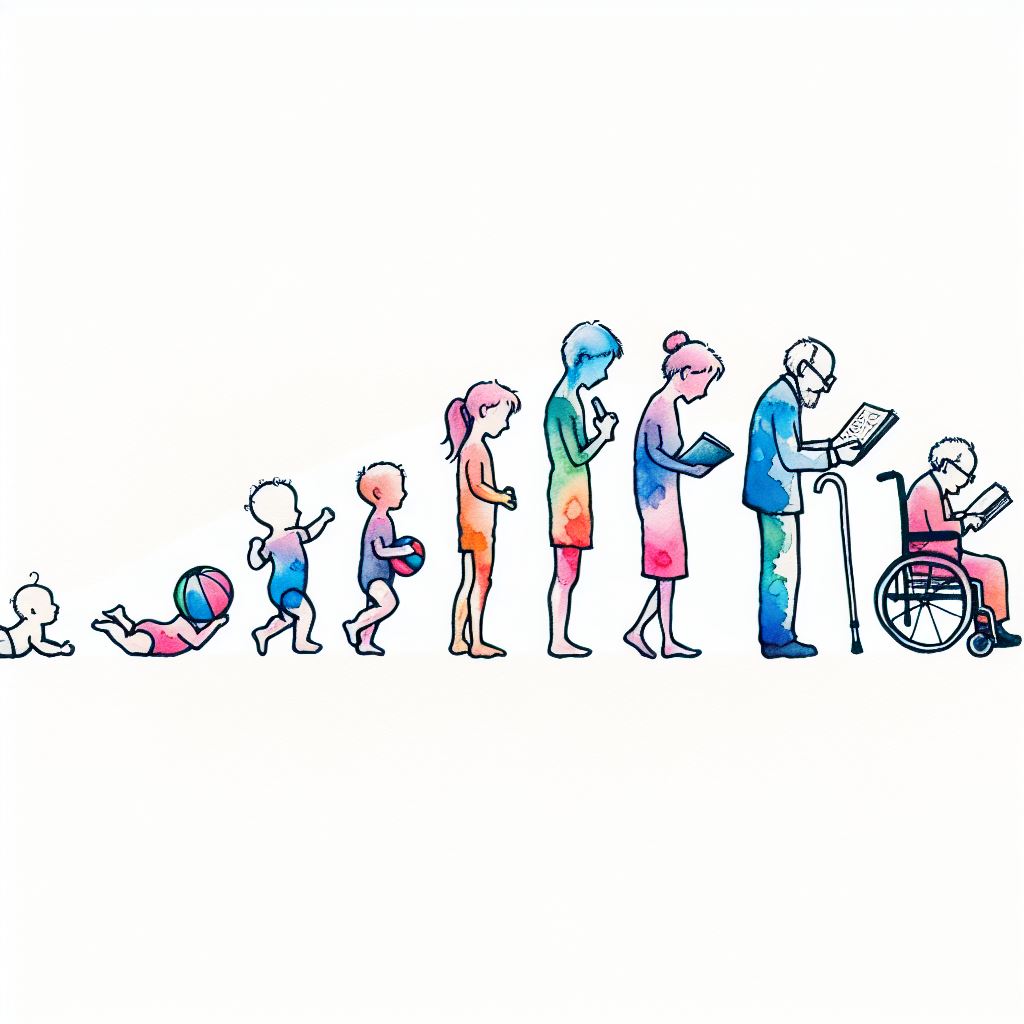
The below information is derived from the textbook “Psychology Themes & Variations”.
Resources
| Podcast | Download |
| Multiple Choice Quiz | Click Here |
Key Learning Goals
The key learning goals of the chapter are:
Outline the major events of the three stages of prenatal development.
The germinal stage is the first phase of prenatal development, encompassing the first two weeks after conception. This stage begins when a zygote is created through fertilization, which rapidly divides into a mass of multiplying cells. The cell mass slowly migrates along the mother’s uterus wall.
The embryonic stage lasts from two weeks until the end of the second month. During this stage, most of the vital organs and bodily systems begin to form in the developing organism, now called an embryo. Structures such as the heart, spine, and brain emerge gradually, and by the end of this stage, the embryo begins to look human with discernible arms, legs, hands, feet, fingers, toes, eyes, and ears. The embryonic stage is a period of great vulnerability because virtually all basic physiological structures are being formed.
The fetal stage lasts from two months through birth. The first two months of the fetal stage bring rapid bodily growth as muscles and bones begin to form. The developing organism, now called a fetus, becomes capable of physical movements as skeletal structures harden. Organs formed in the embryonic stage continue to grow and gradually begin to function. During the final three months of the prenatal period, brain cells multiply at a brisk pace and a layer of fat is deposited under the skin to provide insulation, readying the fetus for life outside the womb.
Summarize the impact of environmental factors on prenatal development.
Events in the external environment can affect the fetus indirectly through the mother. A mother’s eating habits, drug use, and physical health can affect the developing organism through the placenta.
Maternal malnutrition during the prenatal period has been linked to birth complications and other problems.
Maternal emotions in reaction to stressful events can impact prenatal development. Elevated levels of prenatal stress have been associated with increased stillbirths, impaired immune response, and slowed motor development.
Maternal illnesses, such as measles and rubella, can interfere with prenatal development.
Even moderate drinking during pregnancy can have substantial negative effects, and the safest course of action is to abstain from alcohol during pregnancy.
Maternal nutrition continues to affect the newborn during the breastfeeding period.
Understand the role of maturation and cultural variations in motor development.
Maturation is development that reflects the gradual unfolding of one’s genetic blueprint. It is a product of genetically programmed physical changes that come with age rather than through experience and learning.
Infants are active agents, not passive organisms waiting for their brain and limbs to mature.
Cross-cultural research has highlighted the dynamic interplay between experience and maturation in motor development.
Relatively rapid motor development has been observed in some cultures that provide special practice in basic motor skills.
Relatively slow motor development has been found in some cultures that discourage motor exploration.
The similarities across cultures in the sequence and timing of early motor development outweigh the differences, suggesting that early motor development depends to a considerable extent on maturation.
Describe Harlow’s and Bowlby’s views on attachment, and discuss research on patterns of attachment.
Harlow’s studies of infant monkeys showed that reinforcement is not the key to attachment.
Bowlby argued that attachment has a biological and evolutionary basis. Parent-child attachments make crucial contributions to outcomes by fostering social and emotional development in children.
Research by Ainsworth suggests that infant-mother attachments fall into three categories: secure, anxious-ambivalent, and avoidant.
Infants with a relatively secure attachment tend to become resilient, competent toddlers with high self-esteem.
Other research from around the world suggests that attachment is a universal feature of human development.
Describe the basic tenets of Erikson’s theory and his stages of childhood personality development.
Erikson’s theory describes development in terms of stages. A stage is a developmental period during which characteristic patterns of behaviour are exhibited and certain capacities become established.
Individuals must progress through specified stages in a particular order because each stage builds on the previous stage.
Progress through these stages is strongly related to age.
Development is marked by major discontinuities that usher in dramatic transitions in behaviour.
Erikson described the stages in terms of antagonistic tendencies, which represent personality traits that people display in varying degrees over the remainder of their lives.
The first four childhood stages in Erikson’s theory are:
- Trust versus mistrust which encompasses the first year of life when an infant depends completely on adults to take care of their basic needs. If those needs are adequately met and sound attachments are formed, the child should develop an optimistic, trusting attitude toward the world.
- Autonomy versus shame and doubt which unfolds during the second and third years of life when parents begin toilet training and other efforts to regulate the child’s behaviour. If all goes well, the child acquires a sense of self-sufficiency.
- Initiative versus guilt lasting roughly from ages three to six, when children experiment and take initiatives that may sometimes conflict with their parents’ rules. Overcontrolling parents may begin to instill feelings of guilt, and self-esteem may suffer.
- Industry versus inferiority (age six through puberty) when the challenge of learning to function socially is extended beyond the family to the broader social realm of the neighbourhood and school. Children who are able to function effectively in this less nurturant social sphere where productivity is highly valued should learn to value achievement and to take pride in accomplishment, resulting in a sense of competence.
Describe Piaget’s and Vygotsky’s theories of cognitive development, and evaluate the notion that some cognitive abilities may be innate.
Piaget proposed that youngsters progress through four major stages of cognitive development, which are characterized by fundamentally different thought processes:
The sensorimotor period (birth to age two), when infants develop the ability to coordinate their sensory input with their motor actions and develop object permanence.
The preoperational period (ages two to seven), when children gradually improve in their use of mental images, though their thought is marked by shortcomings such as centration, animism, irreversibility, and egocentrism.
The concrete operational period (ages 7 to 11), when children develop the ability to perform operations on mental representations and master the principle of conservation.
The formal operational period (age 11 onward), when thought becomes more systematic, abstract, and logical, and youngsters can apply operations to abstract concepts as well as concrete objects.
Piaget’s theory has been criticized for underestimating some aspects of children’s cognitive development, the mixing of stages, and the impact of culture.
Vygotsky’s sociocultural theory asserts that children’s cognitive development is shaped by social interactions, language progress, and cultural factors.
- Vygotsky placed enormous emphasis on how children’s cognitive development is fuelled by social interactions with parents, teachers, and older children who can provide guidance.
- He argued that language acquisition plays a crucial, central role in fostering cognitive development.
- He saw cognitive development as more like an apprenticeship than a journey of individual discovery and highlighted the zone of proximal development and scaffolding.
Researchers have found that infants understand complex concepts that they have had little opportunity to acquire through learning, leading some theorists to conclude that some basic cognitive abilities are wired into humans’ neural architecture.
Discuss Kohlberg’s stages of moral development and criticism of his theory.
Kohlberg’s theory proposes that individuals progress through three levels of moral reasoning:
- Preconventional reasoning focuses on acts’ consequences.
- Conventional reasoning focuses on the need to maintain social order.
- Postconventional reasoning focuses on working out a personal code of ethics.
Age-related progress in moral reasoning has been found in research, but there is a lot of overlap between stages.
Review the physiological changes of puberty, and summarize research on neural development in adolescence.
Puberty is the stage during which sexual functions reach maturity, which marks the beginning of adolescence.
During puberty, the primary sex characteristics (the structures necessary for reproduction) develop fully.
In females, puberty is typically signalled by menarche (the first occurrence of menstruation).
Hormonal changes during puberty lead to the development of secondary sex characteristics (physical features that distinguish one sex from the other but that are not essential for reproduction).
Brain-imaging studies have shown that the volume of white matter in the brain grows throughout adolescence, while the volume of grey matter declines.
The growth of white matter suggests that neurons are becoming more myelinated, leading to enhanced connectivity in the brain.
The decrease in grey matter is thought to reflect synaptic pruning, which plays a key role in the formation of neural networks.
Discuss identity formation in adolescence and the stage of emerging adulthood.
According to Erikson, the premier challenge of adolescence is the struggle to form a clear sense of identity.
James Marcia proposed that the presence or absence of a sense of commitment and a sense of crisis can combine to produce four different identity statuses: identity diffusion, identity foreclosure, identity moratorium, and identity achievement.
Emerging adulthood is a transitional period between adolescence and adulthood that is characterised by the subjective feeling that one is in between adolescence and adulthood, it is an age of possibilities and it is a self-focused time of life.
Discuss personality development in adulthood, and trace typical transitions in family relations during the adult years.
During adulthood, personality is marked by both stability and change, as percentile scores remain stable but mean raw scores change in predictable ways.
The adult years tend to bring gradual increases in agreeableness, openness to experience, and conscientiousness.
Erikson divided adulthood into three stages: intimacy versus isolation, generativity versus self-absorption, and integrity versus despair.
Many of the important transitions in adulthood involve changes in family responsibilities and relations.
Describe the physical changes associated with aging, and summarize information on Alzheimer’s disease.
The amount of brain tissue and brain weight decline gradually in late adulthood, mostly after age 60.
Dementia is an abnormal condition marked by multiple cognitive deficits that include memory impairment.
Alzheimer’s disease is a form of dementia that involves a profound and widespread loss of neurons and brain tissue.
The hallmark early symptom of Alzheimer’s is the forgetting of newly learned information after surprisingly brief periods of time.
Understand how memory and mental speed change in later adulthood.
Many studies have found decreases in older adults’ memory capabilities.
Episodic memory appears to be more vulnerable than semantic memory to age-related decline.
Speed in cognitive processing tends to begin a gradual decline during middle adulthood.
Some studies suggest that high levels of mental activity in late adulthood can delay the typical age-related declines in cognitive functioning.
Discuss attitudes about death, the process of dying, and variations in how people cope with bereavement.
People confronting death spoke more of love, meaning, and social connection than they did of regret, sadness, or terror.
Kubler-Ross concluded that people evolve through a series of five stages as they confront their death (denial, anger, bargaining, depression, and acceptance), but some subsequent studies did not find the same progression.
Cultural variations exist in how people cope with bereavement.
Identify the five unifying themes highlighted in this chapter.
The chapter touched on theoretical diversity, the fact that psychology evolves in a sociohistorical context, multifactorial causation of behaviour, cultural invariance and diversity, and how heredity and environment jointly mould behaviour.
Summarize evidence on gender differences in behaviour, and assess the significance of these differences.
There are genuine, but small, gender differences in cognitive abilities.
- On average, females tend to exhibit slightly better verbal skills than males.
- Starting during high school, males show a slight advantage on tests of mathematical ability.
There is far more variation within each sex than between the sexes.
Explain how biological and environmental factors are thought to contribute to gender differences.
Evolutionary psychologists argue that universal gender differences reflect different natural selection pressures operating on males and females.
Some theorists have tried to link gender differences to the specialization of the cerebral hemispheres in the brain.
Socialization is the acquisition of the norms and behaviours expected of people in a particular society.
Operant conditioning, observational learning, and self-socialization contribute to the development of gender differences.
Clarify and critique the argument that fathers are essential for healthy development.
There are a number of flaws and weaknesses in the argument that fathers are essential to normal development, however, that doesn’t mean that fathers are unimportant. Many types of evidence suggest that fathers generally make significant contributions to their children’s development.
The position that fathers are essential for healthy development rests on a foundation of correlational evidence, and correlation is no assurance of causation.
There may be alternative explanations for findings that you might have doubts about.
There is contradictory evidence which shows no difference in the adjustment of children raised by heterosexual parents and those raised by lesbian parents.