
Resources
| Podcast | Download |
Summaries
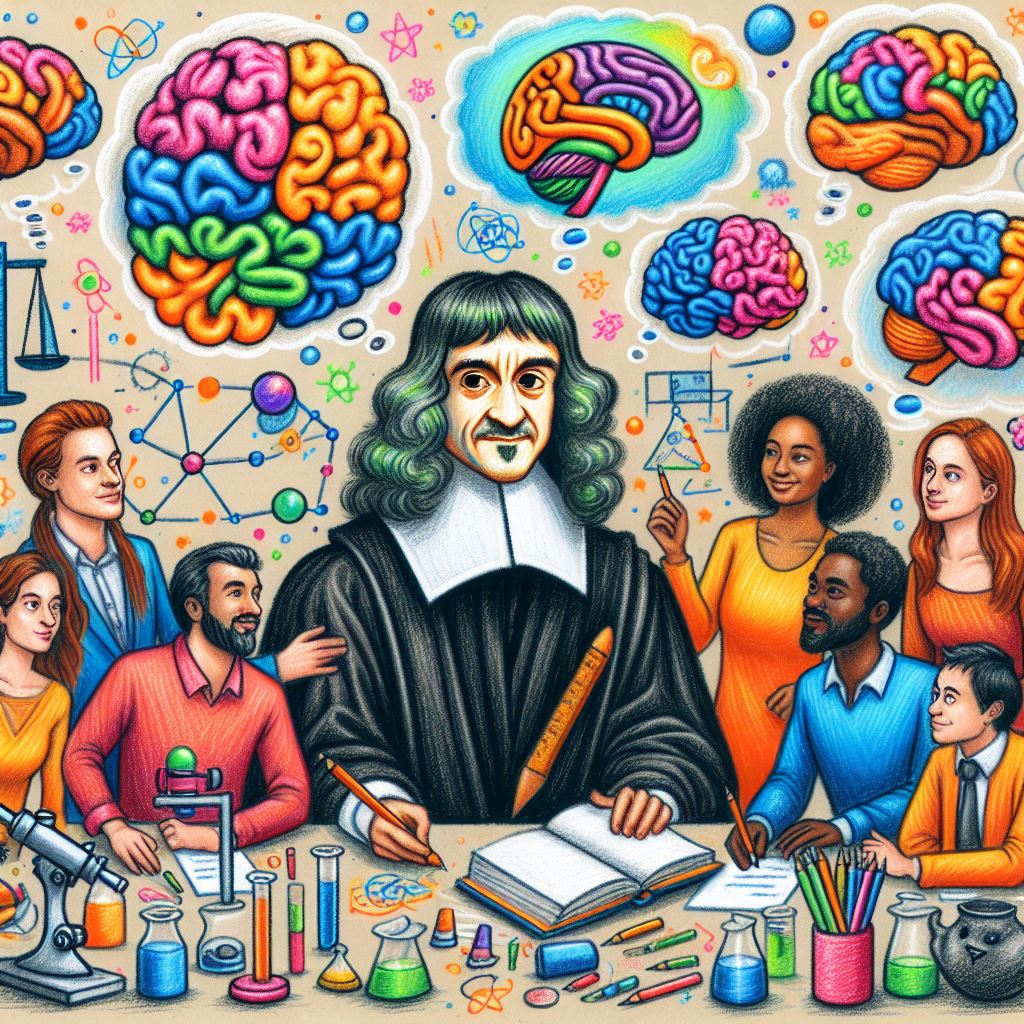
Descartes Summary
The sources primarily discuss the mind-body problem, focusing on how the mind and body interact, given their seemingly different properties. The article highlights that this is not just a matter of how they relate, but how they can relate, considering their distinct natures.
Key points include:
- The core of the mind-body problem: The problem is that minds and bodies are so different that their interaction appears impossible.
- Descartes’s Contribution: René Descartes is often credited with identifying the problem, although he saw it more as a solution. He defined matter as spatial with linear dimensions, while he defined the mind as conscious without spatial dimensions.
- Critiques of Descartes: Critics, notably Princess Elisabeth of Bohemia and Pierre Gassendi, challenged Descartes’s view. They argued that for the mind to affect the body, it would need to have a spatial presence, which contradicts Descartes’s definition of the mind.
- The interaction challenge: The central question is how the non-spatial mind can interact with the spatial body. Princess Elisabeth pointed out that any interaction would require contact and extension, qualities Descartes specifically excluded from the mind.
- Descartes’s proposed solution: Descartes proposed the pineal gland as the site of interaction, but this is problematic since the pineal gland is a physical part of the body.
- The problem persists: The fundamental issue is the lack of common terms to describe both the physical and psychological aspects of the mind-body relationship. Concepts like color are psychological, while terms like neurons and electromagnetic radiation are physical. The challenge lies in bridging these different kinds of concepts.
- Historical Context: While thinkers before Descartes had considered the mind or soul and its relationship to the body, they did not formulate the problem with the same precision as Descartes’s critics. The rise of mechanical explanations in the 17th century brought the problem into sharper focus, highlighting the difficulty of explaining how consciousness fits into a physical and mechanical view of the world.
- The ghost in the machine: The text uses an analogy of a ghost trying to lift a coffee cup to illustrate how difficult it is to conceive how a non-physical mind can interact with the physical body. It is no more conceivable than a mind affecting a distant ATM machine.
The sources also provide some details about how the physical body processes information. Light entering the eye is converted to electrical signals that travel to the visual cortex, where it seems, miraculously, a person becomes conscious of seeing the coffee cup. This physical process is where the interaction between the physical and non-physical becomes problematic.
Video Summary
Cognitive science is an interdisciplinary study of the mind as an information processor, exploring its complexities and functions.
Highlights
- ? Cognitive Science studies the mind and its functions.
- ? It’s interdisciplinary, combining psychology, neuroscience, linguistics, computer science, anthropology, and philosophy.
- ? Mental states are defined by their functions, not just their physical structures.
- ? Information processing is a key lens for understanding cognition.
- ? The mind’s nature raises questions about consciousness, intelligence, and the essence of thought.
- ? Collective behavior in animals suggests shared mental processes.
- ? The exploration of what constitutes a “mind” remains ongoing and complex.
Key Insights
- ? Interdisciplinary Nature: Cognitive science integrates various fields to address complex questions about the mind, emphasizing the need for diverse perspectives. This approach enriches our understanding and opens new avenues for research.
- ? Functionalism vs. Physicalism: Mental states are viewed through functionalism, asserting they cannot be solely identified with physical brain states. This distinction emphasizes the importance of the role and function of mental states rather than their physical substrate.
- ? Information Processing: Understanding the mind as an information processor allows for a structured analysis of cognitive functions, framing mental activities as inputs and outputs. This perspective aligns with advancements in computer science and artificial intelligence.
- ? Collective Cognition: The behavior of social animals, such as termites, raises intriguing questions about collective intelligence and shared mental processes, suggesting that cognition can be distributed across individuals and systems.
- ? Consciousness and Identity: The exploration of consciousness is central to cognitive science, questioning whether consciousness is essential for a mind and how identity is constructed in relation to mental states.
- ? Diversity of Experience: Anthropology contributes to our understanding of human cognition by highlighting cultural differences and the range of human experiences, thus broadening the scope of cognitive science.
- ? Ongoing Questions: The nature of the mind, its relationship to the brain, and what constitutes thought remain deeply debated topics, inviting personal reflection and continued exploration in cognitive science.